


Systematic Review vs Meta-Analysis: 7 Key Differences
Systematic Review vs Meta-Analysis: 7 Key Differences
Understanding the difference between a systematic review and meta-analysis is one of the most common confusions among medical postgraduate students. If you are pursuing an MD, MS, DNB, PhD, DM, MCh, or MSc Nursing degree, your thesis guide may ask you to conduct one of these — but which one should you choose? In addition, there are other review types like narrative reviews, scoping reviews, and bibliometric analyses that serve entirely different purposes. This comprehensive guide breaks down each type so you can make the right decision for your thesis. Systematic Review vs Meta-Analysis
📑 Table of Contents
📚 What Is a Systematic Review?
A systematic review is a structured research method that collects, appraises, and synthesizes all available evidence to answer a specific clinical question. Unlike a simple literature review, it follows a transparent and reproducible protocol that is defined before the search begins. As a result, systematic reviews sit at the top of the evidence hierarchy in evidence-based medicine.
Furthermore, every step — from formulating the research question using PICO framework (Population, Intervention, Comparison, Outcome) to screening studies and extracting data — is pre-planned and thoroughly documented. Consequently, the risk of selection bias is significantly reduced compared to a narrative review.
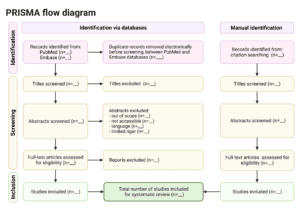
: PRISMA flow diagram showing the systematic review study selection process (Identification → Screening → Eligibility → Included)
In other words, a systematic review uses explicit and reproducible methods to identify all relevant studies. This is what differentiates it from a descriptive review based on whatever papers the author happens to know. Most importantly, systematic reviews must be registered on platforms like PROSPERO and reported following PRISMA guidelines.
🔑 Key Takeaway
A systematic review is a research methodology — not just a literature survey. It can exist independently without any statistical pooling. Think of it as the foundation on which a meta-analysis may or may not be built.
📊 What Is a Meta-Analysis?
A meta-analysis is a statistical technique that combines the quantitative results from multiple individual studies to produce a single pooled estimate of effect. It is typically performed within the framework of a systematic review. However, not every systematic review includes a meta-analysis — and this is where most students get confused.
Specifically, a meta-analysis uses mathematical methods to calculate an overall effect size. Common effect measures include odds ratio (OR), risk ratio (RR), weighted mean difference (WMD), and standardized mean difference (SMD). The results are then displayed using a forest plot, which visually shows each study’s effect estimate alongside the combined summary measure.
Moreover, meta-analyses often include subgroup analysis and meta-regression to explore factors that might influence the relationship between treatment and outcome. Additionally, heterogeneity is assessed using I² statistics and Cochran’s Q test to determine whether the studies are similar enough to be combined.
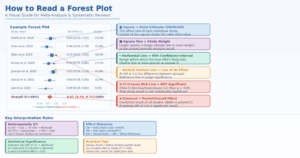
: Example forest plot showing individual study results with diamond-shaped pooled estimate at bottom
💡 Pro Tip
A meta-analysis is only possible when included studies are sufficiently similar in design, population, intervention, and outcomes. If your systematic review finds highly heterogeneous studies, you should present a narrative synthesis instead of forcing a meta-analysis. Software like RevMan, R (meta/metafor packages), Stata, or CMA can help you perform the statistical pooling.
⚖️ Systematic Review vs Meta-Analysis — 7 Key Differences
Now that you understand each term individually, let us look at the core differences between a systematic review and a meta-analysis. This comparison will help you quickly grasp the distinctions that matter for your thesis.
In summary, a meta-analysis is a subset of a systematic review. Every meta-analysis involves a systematic review, but not every systematic review includes a meta-analysis. This is the single most important point to remember for your thesis.
6–18
Months for a SR + MA
Top
Level of Evidence
PRISMA
Reporting Guideline
2+
Studies Needed for MA
Finding systematic reviews and meta-analyses overwhelming? PubMedico can handle everything — from protocol registration to forest plots and manuscript writing.
📝 Other Review Types You Should Know
Beyond the systematic review vs meta-analysis comparison, medical thesis students often encounter several other review types. Understanding these is equally important because choosing the wrong review type can derail your entire thesis project. Let us explore each one in detail.
Narrative Review (Literature Review)
A narrative review provides a broad summary of existing research on a topic without following a rigid protocol. The author selects studies based on their own knowledge and judgment. Consequently, narrative reviews are more prone to selection bias compared to systematic reviews. Nevertheless, they remain valuable for providing comprehensive overviews, especially in thesis introduction chapters and textbook contributions.
✅ Best for: Thesis introduction chapters, textbook contributions, broad topic overviews
Scoping Review
A scoping review maps the existing evidence on a topic to identify research gaps, key concepts, and the overall scope of available literature. Unlike a systematic review, it does not typically assess the quality of included studies. Furthermore, scoping reviews are particularly helpful when you are exploring a new or emerging research area. They can also serve as a precursor to a full systematic review, helping you determine whether enough evidence exists.
✅ Best for: Exploring emerging topics, mapping research gaps, planning future systematic reviews
Bibliometric Analysis
A bibliometric analysis uses quantitative methods to analyze publication patterns, citation networks, authorship trends, and keyword co-occurrences within a body of literature. Tools like Bibliometrix/Biblioshiny (in R) and VOSviewer are commonly used. Moreover, bibliometric analyses are gaining popularity in Indian medical research because they do not require ethical approval or patient data. As a result, they offer an excellent thesis option for students who want to avoid clinical data collection.
✅ Best for: Publication trend analysis, identifying key contributors, thesis topics without clinical data
Umbrella Review (Review of Reviews)
An umbrella review synthesizes findings from multiple existing systematic reviews on a related topic. It sits at the very top of the evidence hierarchy. Therefore, it is suitable when several systematic reviews already exist and you want to compare their conclusions. In particular, umbrella reviews are increasingly used for developing clinical practice guidelines.
✅ Best for: Topics with multiple existing SRs, policy-level evidence summaries
Rapid Review
A rapid review uses streamlined systematic review methods to produce findings in a shorter timeframe. It achieves this by narrowing the research question, using simpler search strategies, and performing less rigorous quality assessments. However, the trade-off is an increased risk of bias. Rapid reviews became especially popular during the COVID-19 pandemic when quick evidence summaries were needed for policy decisions.
✅ Best for: Time-sensitive policy decisions, preliminary evidence assessments
Critical Review
A critical review goes beyond simple description and engages in deep analysis and interpretation of the existing literature. It evaluates the strengths and weaknesses of research, critiques methodologies, and often proposes new theoretical models. Additionally, critical reviews are subjective and interpretive in nature, emphasizing conceptual innovation and theoretical development.
✅ Best for: Rethinking existing frameworks, proposing new models, theoretical 📋 Complete Comparison of All Review Types
Here is a comprehensive side-by-side comparison of all major review types. This table will help you quickly determine which approach fits your thesis research question best.
🎯 How to Choose the Right Review for Your Thesis
Selecting the correct review type is one of the most critical decisions you will make during your thesis journey. Here is a simple decision framework to guide you through the process.
Q1: Do you have a focused clinical question with a specific intervention? → Systematic Review (± Meta-Analysis)
Q2: Is the topic broad or still emerging with limited evidence? → Scoping Review
Q3: Do you want to analyze publication trends without patient data? → Bibliometric Analysis
Q4: Are there multiple existing systematic reviews on your topic? → Umbrella Review
Q5: Do you just need a broad overview for your thesis introduction? → Narrative Review
Q6: Is there a tight deadline and you need quick evidence? → Rapid Review
⚠️ Warning
Many Indian universities and thesis guides still use “systematic review” and “meta-analysis” interchangeably in their guidelines. Always clarify with your guide which type they actually expect. Submitting a narrative review when a systematic review was required can lead to thesis rejection — even at the final viva stage.
Additionally, consider the practical constraints of your thesis timeline. A full systematic review with meta-analysis typically takes 6–18 months. If you are in the final year of your MD/MS program with limited time remaining, a scoping review or bibliometric analysis might be a more realistic choice. On the other hand, if your university specifically requires level-1 evidence, a systematic review is the only acceptable option.
If you find this decision-making process overwhelming, professional thesis writing services like PubMedico can help you choose the right review type, design your protocol, and execute the entire project from search strategy to final manuscript.
🚫 Common Mistakes Students Make
Based on years of working with medical postgraduate students across India, here are the most frequent errors that can derail your review article thesis:
Mistake 1: Using “systematic review” and “meta-analysis” interchangeably in the thesis title and protocol. Reviewers and examiners will immediately notice this confusion.
Mistake 2: Forcing a meta-analysis when the included studies are highly heterogeneous. A narrative synthesis is perfectly acceptable when studies cannot be meaningfully combined.
Mistake 3: Not registering the systematic review protocol on PROSPERO before starting data extraction. Most high-impact journals now require PROSPERO registration.
Mistake 4: Calling a narrative review a “systematic review” just because you searched PubMed systematically. A true systematic review requires a pre-defined protocol, dual screening, and quality assessment — not just a database search.
Mistake 5: Ignoring grey literature and conference abstracts. A comprehensive systematic review should search beyond PubMed — include Embase, Cochrane, Google Scholar, trial registries, and relevant conference proceedings.
💚 Did You Know?
The number of published systematic reviews and meta-analyses has grown exponentially over the past decade. Indian medical colleges are increasingly accepting review articles as thesis topics — making it more important than ever to understand the differences between review types. Choosing correctly from the start saves months of wasted effort. Systematic Review vs Meta-Analysis: 7 Key Differences
❓ Frequently Asked Questions
Q: Can a systematic review be done without a meta-analysis?
Yes, absolutely. A systematic review can present its findings through narrative synthesis alone. A meta-analysis is only added when the included studies are similar enough to be statistically pooled. In fact, many published systematic reviews do not include meta-analyses because the studies were too heterogeneous.
Q: Which review type is best for an MD/MS thesis in India?
For most Indian medical universities, a systematic review with or without meta-analysis is the most accepted and valued review type. However, scoping reviews and bibliometric analyses are also gaining acceptance. Always check with your university guidelines and thesis guide before deciding.
Q: How many studies are needed for a meta-analysis?
Technically, a meta-analysis can be performed with as few as two studies. However, pooling results from only two or three studies produces unstable estimates. Most experts recommend having at least five or more comparable studies for a reliable meta-analysis with meaningful confidence intervals.
Q: What is the difference between a narrative review and a systematic review?
A narrative review summarizes literature based on the author’s selection without a formal protocol, making it prone to bias. A systematic review follows a pre-defined protocol with transparent search strategies, dual screening, and quality assessment — making it reproducible and minimizing bias.
Q: Is a bibliometric analysis easier than a systematic review?
In many ways, yes. A bibliometric analysis does not require ethical approval, patient data, or dual-reviewer screening. It primarily involves downloading bibliographic data from databases like Scopus or Web of Science and analyzing it using tools like Bibliometrix or VOSviewer. However, it requires R programming skills and cannot answer clinical questions the way a systematic review can.
🎓
Need Expert Help With Your Review Article Thesis?
PubMedico provides end-to-end thesis writing and research support for MD, MS, DNB, PhD, DM, MCh, and MSc Nursing students across all specialties.
Our services include: Systematic review protocol design, PROSPERO registration, literature search, data extraction, meta-analysis (forest plots, funnel plots, subgroup analysis), bibliometric analysis, PRISMA flow diagrams, risk of bias assessment, manuscript writing, and journal publication support.