

E
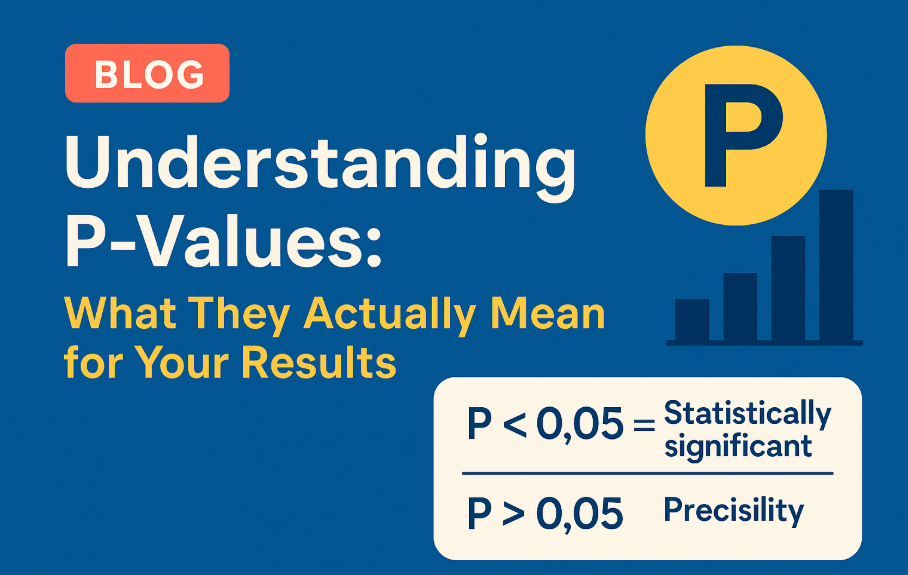
Understanding P-Values: What They Actually Mean for Your Results
A practical guide for MD/MS residents to interpret “P < 0.05” correctly in thesis and research.
🔍 Why P-Values Matter in Your Thesis
Every time you run a t-test, chi-square test, ANOVA, correlation, or regression, your software gives you a P-value. Most medical PG students simply look at one rule: “P < 0.05 = significant, P > 0.05 = not significant.” But this oversimplification often leads to confusion and wrong interpretation in the discussion chapter.
In reality, a P-value does not tell you whether your hypothesis is true or false, nor does it measure the size or importance of the effect. This article explains P-values in clear, clinical language, so you can confidently interpret your thesis results and answer examiners during your viva.
📌 What Is a P-Value, in Simple Terms?
A P-value is the probability of obtaining the data (or something more extreme) that you observed in your study, assuming that the null hypothesis is true.
In plain language: A P-value tells you how compatible your data are with “no real difference / no real association”. A small P-value means your data are unlikely if there is truly no effect.
In most biomedical research, the null hypothesis (H0) states that there is no difference between groups or no association between variables. The alternative hypothesis (H1) states that there is some difference or association.
- Example H0: There is no difference in mean HbA1c between the two treatment groups.
- Example H1: There is a difference in mean HbA1c between the two treatment groups.
The P-value therefore answers this question: “If there is actually no difference, how likely is it to see a result as extreme as mine, just by random chance?”
🎯 Why Is 0.05 Used as a Cut-Off?
Traditionally, researchers use α = 0.05 (5%) as the significance level. This means they are willing to accept a 5% chance of saying there is a difference when actually there is none (this is called a Type I error).
If P < 0.05
Your data are unlikely under the null hypothesis. You call the result “statistically significant” and usually reject H0.
If P ≥ 0.05
Your data are compatible with H0. You say the result is “not statistically significant” and do not reject H0.
Remember: 0.049 and 0.051 are not magically different universes. The 0.05 threshold is a convention, not a divine rule.
🩺 Clinical Example: Interpreting a P-Value
Suppose you compare two antihypertensive drugs in 100 patients each and find:
- Mean reduction in systolic BP with Drug A: 18 mmHg
- Mean reduction with Drug B: 12 mmHg
- Difference: 6 mmHg
- Independent t-test gives P = 0.02
Interpretation: If there were really no difference between the drugs, the chance of observing a difference of 6 mmHg (or more) in your sample purely by random variation is about 2%. Since this is less than 5%, you conclude that the difference is statistically significant.
Notice what you cannot say:
- “There is a 98% chance that Drug A is better.” ❌
- “The probability that the null hypothesis is true is 2%.” ❌
⚠ Common Misconceptions About P-Values
Myth 1: “P-Value tells the probability that my hypothesis is true.”
No. P-value assumes that the null hypothesis is already true and then measures how unusual your data are under that assumption. It never gives the probability that the hypothesis is true or false.
Myth 2: “A smaller P-Value means a bigger effect.”
A very small P-value (e.g., 0.0001) does not automatically mean the difference is huge. It might come from a large sample size, where even tiny differences become statistically significant. You must also look at effect size and confidence intervals.
Myth 3: “Non-significant (P ≥ 0.05) means no effect.”
Not always. A non-significant result may simply reflect small sample size, large variability, or inadequate study power. In your thesis discussion, it is better to say “no statistically significant difference was detected” rather than “there is no difference.”
💊 P-Value vs. Clinical Significance
A result can be **statistically significant** but **clinically unimportant**, or vice versa.
- A large trial finds a 1 mmHg BP difference with P = 0.001. Statistically significant, but clinically trivial.
- A small ICU study finds a 10% absolute reduction in mortality with P = 0.07. Not “statistically significant”, but clinically very interesting and worth further research.
In your MD/MS thesis, always comment on both: “statistical significance” and clinical relevance of your findings.
📝 How Should You Report P-Values in Your Thesis?
- Report the exact P-value (e.g., P = 0.032) instead of just “significant”.
- Combine P-values with means, standard deviations, or proportions.
- Always show confidence intervals when possible.
- Write the interpretation in words, for example: “There was a statistically significant reduction in pain score in the intervention group compared to control (P = 0.01).”
🎓 Practical Tips for MD/MS Residents
- Plan your sample size before starting the study to avoid under-powered results.
- Do not chase P-values alone; think about effect sizes and confidence intervals.
- Use appropriate tests (chi-square, t-test, ANOVA, etc.) based on your data type.
- In the discussion chapter, compare your P-value and effect size with previous studies.
- Be honest about non-significant findings; they also add value to evidence.
❓ FAQs About P-Values
No. Universities do not demand that all results must be significant. What matters is that your study is well-designed, ethically conducted, correctly analysed, and properly interpreted.
Not at all. It simply means your result did not cross the conventional 0.05 threshold. Describe the trend, effect size, and limitations instead of labelling it as a failure.
Yes, you can highlight very strong evidence against the null hypothesis using thresholds like 0.01 or 0.001, especially in large studies, but still interpret them with effect sizes.
📚 Still Confused About Statistics in Your Thesis?
If you need help choosing tests, interpreting P-values, or writing your Results & Discussion chapter, you can get guided support.
Contact PubMedico for thesis statistics guidance – Call/WhatsApp: 9664299381