
Sample Size Calculation for Medical Thesis: Easy Guide
Sample Size Calculation for Medical Thesis: Easy Guide
Sample size calculation is one of the first and biggest hurdles that every medical postgraduate student faces while writing a thesis. Whether you are pursuing MD, MS, DNB, PhD, DM, MCh, or MSc Nursing, your IEC and thesis committee will ask you — “How did you calculate the sample size?” In addition, getting this wrong can lead to underpowered studies or even thesis rejection. This step-by-step guide will teach you the basics of sample size calculation in simple language, with formulas for every major study design.Sample size calculation
📑 Table of Contents
📌 Why Is Sample Size Important?
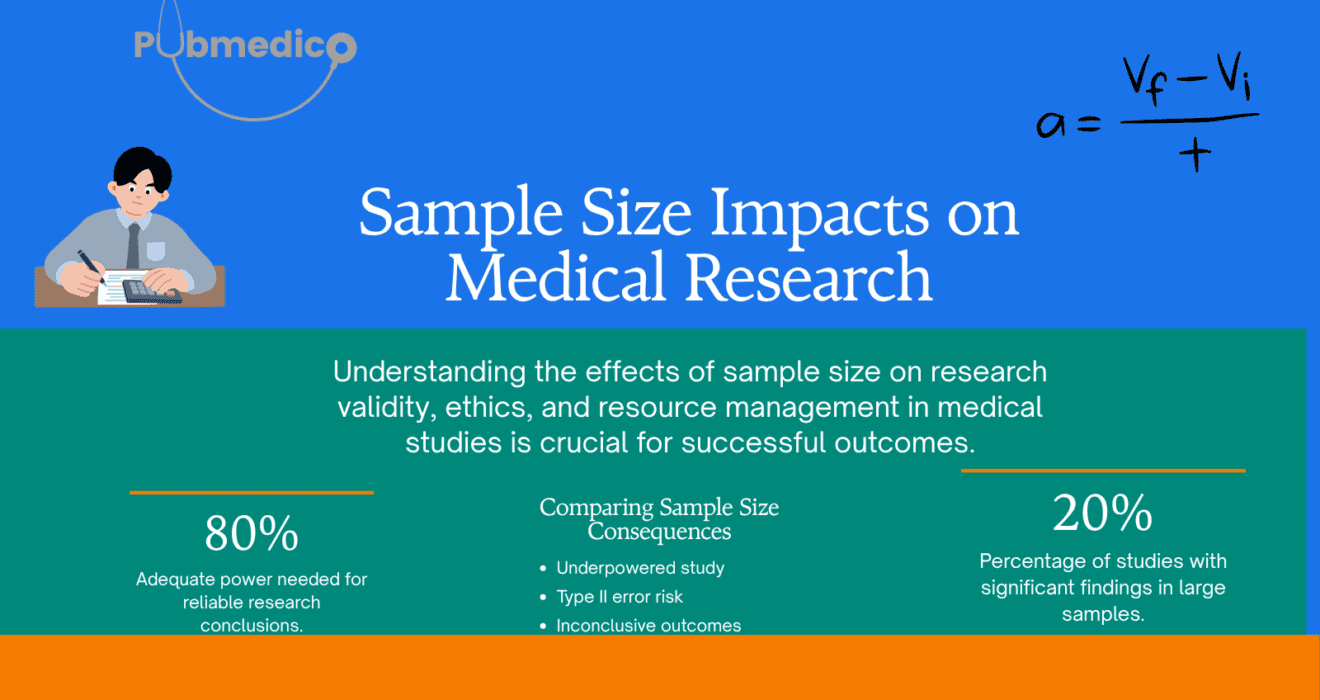
Sample size calculation is a critical step in designing any clinical study. A sample that is too small may fail to detect a real difference between groups — making your study “underpowered.” On the other hand, a sample that is too large wastes resources, time, and may even be unethical because you are exposing more patients to experimental treatments than necessary.
Furthermore, your Institutional Ethics Committee (IEC) and Scientific Research Committee (SRC) will scrutinize your sample size calculation during synopsis presentation. Therefore, getting it right from the beginning saves you from major revisions later. Moreover, journals increasingly require authors to report sample size justification in the methods section.
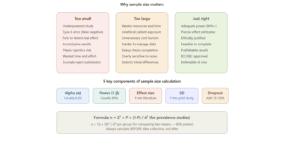
 : Infographic showing consequences of too small vs too large sample size
🔑 Key Takeaway
An adequate sample size ensures your study has enough statistical power (usually 80% or above) to detect a clinically meaningful difference if it truly exists. It is calculated before data collection begins — never after.
🧩 5 Key Components You Must Know
Before you use any formula or software, you need to understand five essential components that go into every sample size calculation. These are the building blocks that your statistician, thesis guide, and IEC will expect you to justify.
Type I Error (Alpha / α)
This is the probability of finding a statistically significant difference when none actually exists — also called a false positive. In most medical research, alpha is set at 0.05 (5%). Consequently, we accept a 5% chance that our result could be due to chance alone. The corresponding confidence level is 95%.
Type II Error (Beta / β) and Power
Type II error is the probability of failing to detect a real difference — a false negative. It is conventionally set at 0.20 (20%). Therefore, statistical power (calculated as 1 − β) is usually 80%. This means your study has an 80% chance of correctly detecting a true effect. Some high-quality studies use 90% power instead.
Effect Size
Effect size is the minimum clinically meaningful difference you want to detect between two groups. For example, if you are comparing two drugs and expect a 10 mg/dL difference in blood glucose levels, that is your effect size. In particular, a larger effect size requires a smaller sample, while a smaller effect size needs more subjects. You can determine effect size from pilot studies, previous research, or clinical experience.
Standard Deviation (SD)
Standard deviation represents how much variability exists in your data. A higher SD means more variability, which in turn requires a larger sample size. You typically obtain the SD from a previous study or a pilot study. Additionally, if the study population is more homogeneous (less variation), the SD will be smaller and you will need fewer subjects.
Dropout Rate
Always add an expected dropout rate (usually 10–20%) to your calculated sample size. For instance, if your formula gives n = 50 per group and you expect 10% dropouts, then the adjusted sample size becomes 50 / (1 − 0.10) = 56 per group. Most importantly, mention this adjustment in your thesis methodology section.
0.05
Alpha (Type I Error)
80%
Statistical Power
10–20%
Dropout Adjustment
1.96
Z-value for 95% CI
📐 Sample Size Formulas by Study Design
The formula you use for sample size calculation depends entirely on your study design. This is the most important point — one single formula cannot work for all designs. Here are the most commonly used formulas for medical thesis research.
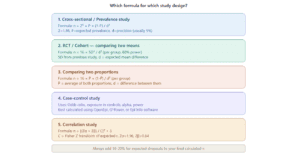
A. Cross-Sectional / Descriptive Study (Estimating a Proportion)
Formula: n = Z² × P × (1 − P) / d²
Z = 1.96 (for 95% confidence level)
P = Expected prevalence/proportion (from literature)
d = Absolute precision/margin of error (usually 5% = 0.05)
Example: Prevalence of anemia in pregnant women = 40% (P = 0.4), precision = 5%
n = (1.96)² × 0.4 × 0.6 / (0.05)² = 3.84 × 0.24 / 0.0025 = 369 subjects
B. Comparative Study — Two Means (RCT / Cohort)
Formula: n = 2 × (Zα + Zβ)² × SD² / d²
Zα = 1.96 (for α = 0.05, two-tailed)
Zβ = 0.84 (for β = 0.20, i.e., 80% power)
SD = Standard deviation (from previous study)
d = Expected difference between two means (effect size)
Simplified: n = 2 × (1.96 + 0.84)² × SD² / d² = 2 × 7.84 × SD² / d²
Or even simpler: n = 16 × SD² / d² (per group, for 80% power)
Example: Comparing two drugs on blood pressure. SD = 12 mmHg, expected difference = 5 mmHg
n = 16 × (12)² / (5)² = 16 × 144 / 25 = 92 per group
C. Comparative Study — Two Proportions
Formula: n = (Zα + Zβ)² × [P1(1−P1) + P2(1−P2)] / (P1 − P2)²
P1 = Proportion in Group 1 (control)
P2 = Proportion in Group 2 (intervention)
Simplified version: n = 16 × P̄ × (1 − P̄) / d²
Where P̄ = (P1 + P2) / 2 and d = |P1 − P2|
Example: Mortality with standard treatment = 60%, expected with new drug = 40%
P̄ = (60+40)/2 = 50%, d = 20%
n = 16 × 50 × 50 / (20)² = 16 × 2500 / 400 = 100 per group
D. Case-Control Study
Uses: Odds Ratio (OR), Proportion of exposure in controls, Alpha, Power
For case-control studies, the sample size depends on the expected odds ratio, the proportion of exposure in the control group, and the desired power. Because the formula is more complex, it is best calculated using software like OpenEpi, G*Power, or Epi Info. Most thesis guides accept software-generated calculations with proper justification of inputs.
E. Correlation Study
Formula: n = [(Zα + Zβ) / C]² + 3
Where C = 0.5 × ln[(1+r)/(1−r)] (Fisher’s Z transformation)
r = Expected correlation coefficient
Example: Expected r = 0.3, α = 0.05, power = 80%
C = 0.5 × ln(1.3/0.7) = 0.5 × 0.619 = 0.31
n = [(1.96 + 0.84) / 0.31]² + 3 = [9.03]² + 3 = 81.5 + 3 ≈ 85 subjects
 : Comparison table showing which formula to use for each study design
💡 Pro Tip
The simplified formula n = 16 × SD² / d² per group (for comparing two means) is incredibly useful for quick mental calculations. It assumes α = 0.05 (two-tailed) and 80% power. AIIMS faculty Dr. Kameshwar Prasad has published this as a practical shortcut for clinicians who need a quick feasibility check.
Struggling with sample size calculation for your thesis? PubMedico can help — from formula selection to complete statistical analysis and results writing.
💻 Free Software and Online Calculators
While understanding the formulas is essential, most thesis committees accept software-calculated sample sizes. Here are the best free tools available for medical researchers in India.
💚 Did You Know?
OpenEpi is the most widely used free online calculator in Indian medical colleges. It covers sample size calculation for cross-sectional, cohort, case-control, and clinical trial designs. You can access it directly from your browser without installing anything — perfect for quick calculations during thesis presentations.
🚫 Common Mistakes Students Make
Based on years of supporting medical thesis projects across India, here are the most frequent sample size errors that PubMedico encounters.
Mistake 1: Using a formula meant for descriptive studies when your design is a comparative study (RCT). The formula for estimating a single proportion is NOT the same as comparing two groups. Always match your formula to your study design.
Mistake 2: Not citing the source of your SD or prevalence values. Your IEC will ask “Where did you get this number?” Always reference the pilot study or published paper from which you obtained these values.
Mistake 3: Forgetting to add a dropout rate adjustment. Your calculated sample size is the minimum needed for analysis. You must recruit more to account for dropouts, non-compliance, and incomplete data.
Mistake 4: Calculating sample size after data collection — this is called post-hoc power analysis and is considered scientifically inappropriate. Sample size must be determined before the study begins.
Mistake 5: Using an unrealistically large effect size to get a smaller sample size. Your thesis examiner will question why you expected such a large difference. Use realistic values from published literature.
✅ Practical Tips for Your Thesis
Here are some battle-tested tips that will make your sample size calculation smooth and defensible during your thesis presentation.
Tip 1: Always write your sample size calculation as a complete sentence in your methodology. For example: “Assuming a prevalence of 40% (based on Kumar et al., 2023), with 95% confidence level and 5% absolute precision, the minimum sample size was calculated as 369 using the formula n = Z²P(1−P)/d².”
Tip 2: If no previous study exists for your topic, conduct a small pilot study of 20–30 subjects first. Use the SD from your pilot study to calculate the main study sample size. This is accepted by most Indian universities.
Tip 3: For systematic reviews and meta-analyses, sample size calculation is not applicable. Instead, you include all studies that meet your inclusion criteria.
Tip 4: For qualitative studies (MSc Nursing), sample size is determined by data saturation — not by a statistical formula. However, most nursing thesis committees expect a minimum of 15–30 participants.
⚠️ Warning
Never copy the sample size calculation from another thesis word-for-word — even if it is the same topic. Your prevalence/SD values, effect size, and reference study must be specific to YOUR research question. IEC reviewers routinely check this and will reject protocols with generic or unverified sample size justifications.
❓ Frequently Asked Questions
Q: What is the minimum sample size for a medical thesis?
There is no universal minimum. The required sample size depends entirely on your study design, expected effect size, and variability. A well-designed pilot study might need only 30 subjects, while a large RCT could require hundreds. Always calculate it using the appropriate formula for your design.
Q: Can I use a convenience sample for my MD/MS thesis?
Some universities allow convenience sampling for observational studies with time-bound data collection. However, you should still justify why a calculated sample size was not feasible. Mention the study duration and expected patient load to defend your convenience sample.
Q: Where can I find the prevalence or SD for my sample size formula?
Search PubMed for studies similar to yours — preferably from Indian settings. Look at their results section for reported prevalence, mean values, and standard deviations. Alternatively, conduct a pilot study of 20–30 subjects and use those values.
Q: Do I need sample size calculation for a case report or case series?
No. Case reports and small case series are descriptive by nature and do not require sample size calculation. However, if your case series is large (more than 30 cases), some reviewers may ask for a justification of the number of cases included.
Q: What if my calculated sample size is too large to achieve?
If the sample size is unfeasible, you have several options. You can increase the effect size (if clinically justified), accept a lower power (70% instead of 80%), reduce the number of groups, or change to a matched-pair design which typically requires fewer subjects. Discuss these trade-offs with your thesis guide before finalizing.
🎓
Struggling With Sample Size Calculation?
PubMedico provides end-to-end thesis writing and research support for MD, MS, DNB, PhD, DM, MCh, and MSc Nursing students across all specialties.
Our services include: Sample size calculation with justification, complete statistical analysis using SPSS/R/Stata, results chapter writing, tables and graphs, methodology drafting, and thesis publication support.